About
The mind is the instrument.
Scale Music grew from a single question: what would happen if, instead of memorizing music, I tried to understand it?
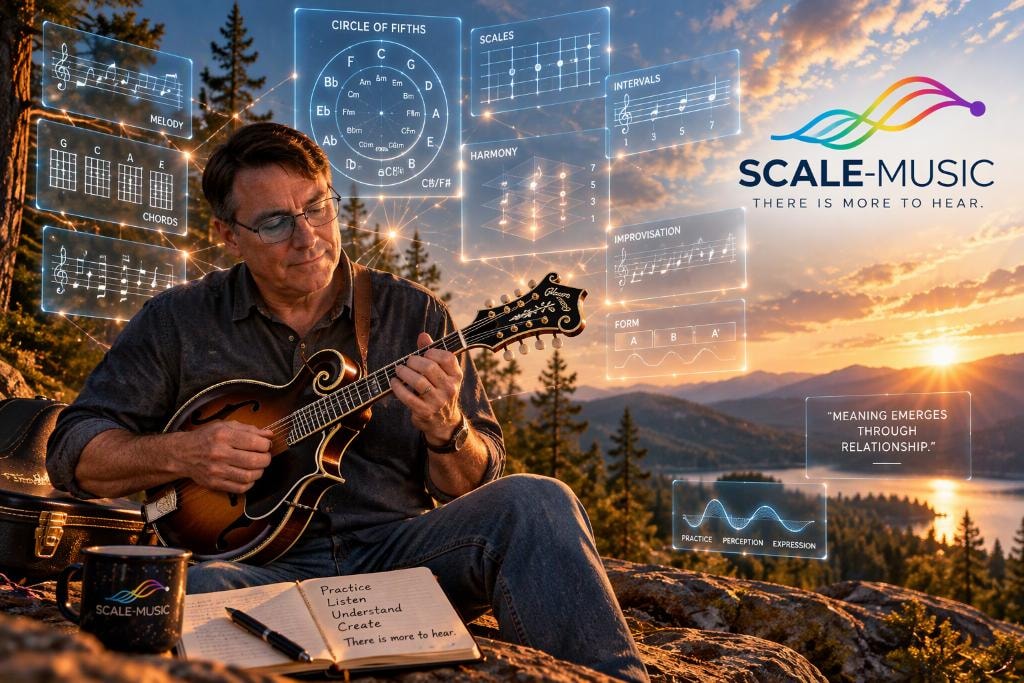
Brian Moore
Founder of Scale Music
Founder of Scale Music
I did not come to music as a lifelong musician, music educator, or traditionally trained theorist.
I came to it as a learner.
And I became fascinated by a simple question: What would happen if, instead of memorizing music, I tried to understand it?
That question changed everything.
I began listening for relationships rather than collecting facts. A note in relation to another note. An interval inside a chord. A chord inside a progression. A progression inside a key. Rhythm, harmony, tension, movement, and resolution gradually stopped feeling like separate subjects and began revealing themselves as parts of one connected system. That progression from sound to relationship to pattern is central to the philosophy that emerged through Scale Music.
The more I understood, the more I realized that I wasn't simply learning music.
I was learning how I learn.
I learn by listening with an open mind, connecting what I observe, looking for patterns, questioning what does not make sense, and moving between the details and the whole until complexity becomes understandable. I try to form the clearest understanding the evidence supports, test it against reality, and remain willing to change that understanding when something new appears. That learning philosophy is explicitly developed in Bridge my learning philosophy.
Music became an extraordinary place to experience that process because relationships are something you can actually hear.
And somewhere along the way, I began to recognize that the same process extended far beyond music.
The way we connect notes into music resembles the way we connect information into understanding. Individual signals acquire meaning through relationship. Relationships reveal patterns. Patterns create context. Context produces clarity. And clarity gives us stronger ground from which to decide and act. That connection became the bridge between Scale Music and the broader idea of Scale.
So Scale Music is not the product of a lifetime spent teaching other people how to play.
It is the product of learning to hear differently, and discovering how much more becomes understandable when we learn to perceive relationships.
That is the experience I want Scale Music to share.
Not simply more musical information.
A different way of seeing, hearing, connecting, and understanding.
The mission
Intelligence expands when perception expands.
Scale Music begins with music, but its deeper subject is perception.
A sound contains information. Another sound creates relationship. Relationships become patterns. Patterns become structure. And eventually the mind stops hearing isolated events and begins hearing something larger.
It hears the whole.
Learning music, then, is not only the acquisition of musical knowledge. It can become the development of our capacity to listen, recognize relationships, tolerate uncertainty, discover structure, and make meaning from complexity. That is the definition of expanded perception developed in the Scale Music work.
The mind is the instrument.
And like any instrument, it can be developed.
The broader idea
Music is one expression of SCALE.
The principles underneath Scale Music extend beyond music.
Listen. Connect. Recognize. Clarify. Decide. Act. Listen again.
They describe a continuous movement from perception to understanding, from understanding to action, and from action back to learning. The broader SCALE work develops precisely that closed loop, where action changes reality and creates the next signals to perceive.
In music, we hear sounds and discover relationships.
In learning, we encounter information and build understanding.
In organizations, we connect signals and patterns to create clarity and make grounded decisions.
Different domains. The same fundamental movement.
We understand more when we learn to perceive relationships.